The Flaws and Contradictions of Financial Fair Play in European Competition.
- Zachary Lerman
- Sep 17, 2020
- 4 min read

UEFA Financial Fair Play Regulations (FFP) were first implemented in 2009 with the long term goal of preventing professional clubs from spending more than they earn in the pursuit of success in domestic and European competitions.
Sanctions are taken against clubs who exceed spending over several seasons. Some of the severest penalties include disqualification from European competition, withholding prize money, and transfer bans.
The current regulations, which started being implemented in 2012 only allow a club's outgoings in transfers, employee benefits, finance costs, TV revenue, advertising, sale of players, disposal of fixed assets, and merchandising. Any money spent on infrastructure and youth development isn't counted.
FFP's job was to address the insolvency of many European football clubs due to the fact that clubs have been more recently viewed as "profit maximizing enterprises" instead of "utility maximizing enterprises". The difference stems from looking at soccer clubs as a business instead of an integral part of the community. As Steven Syzmanski and Simon Kuper put it in their book Soccernomics "When business people try to run a football club as a business, then not only does the football suffer but so does the business".
Since these laws were implemented, FFP has gone under much criticism for many reasons including the creation of a big club status quo, not addressing questionable sponsorship deals with "sugar daddy" owners, differing tax rates in different economies, and third party ownership of players and clubs.
FFP can be seen as a temporary band aid to the structural issue of ownership in football, which has led to the cannibalization of many European football clubs recently. FFP was created to stop the real threat to football, which was unsustainable loss making and the threat of a European Super League. Some ten years on after its implementation has it gone as far as it claims.
***
In a 2019, University of Edinburgh business professor Roman Gallager and Queen's University's Barry Quinn published a study called Regulatory Own Goals: The Unintended Consequences of Economic Regulation in Professional Football.
In the report, they found that clubs do not bear efficiency decreases equally, meaning the more restrictive limit for financial losses, the worse the average clubs performs. The long term effects mean that when loss limits are reduced, clubs do not try to win games as much as try to win profits thus undermining the competitive quality of the league. Ultimately football clubs are in a state of contradiction chase profits but sacrifice quality and viewership or chase losses with the potential reward of winning. This contradiction specifically affects non-elite clubs more because they often face more budgetary constraints in their quest for glory.
Over the past couple of seasons, UEFA has punished the likes of Rangers, Galatasaray, Rapid Bucharest, Panathinaikos and other smaller European clubs for violating financial regulations in the form of banning them from participating in European competition for several seasons, meaning these clubs missed out on revenue that could have potentially helped the club's short term insolvency crisis.
FFP in its implementation has created a two tiered environment where elite clubs haven't been punished as hard due to their status meanwhile non-elite clubs have been punished more due to their already fragile financial position. These penalties have hurt the smaller non-elite European clubs that are chasing success and quality in their squads (some penalties are justified though), meanwhile Manchester City and Chelsea often clubs with losses above 70 million pounds get away with only transfer bans due to the extremely rich owners that can take these losses and the stability of overseas television money to keep the quality of the league at a high level.
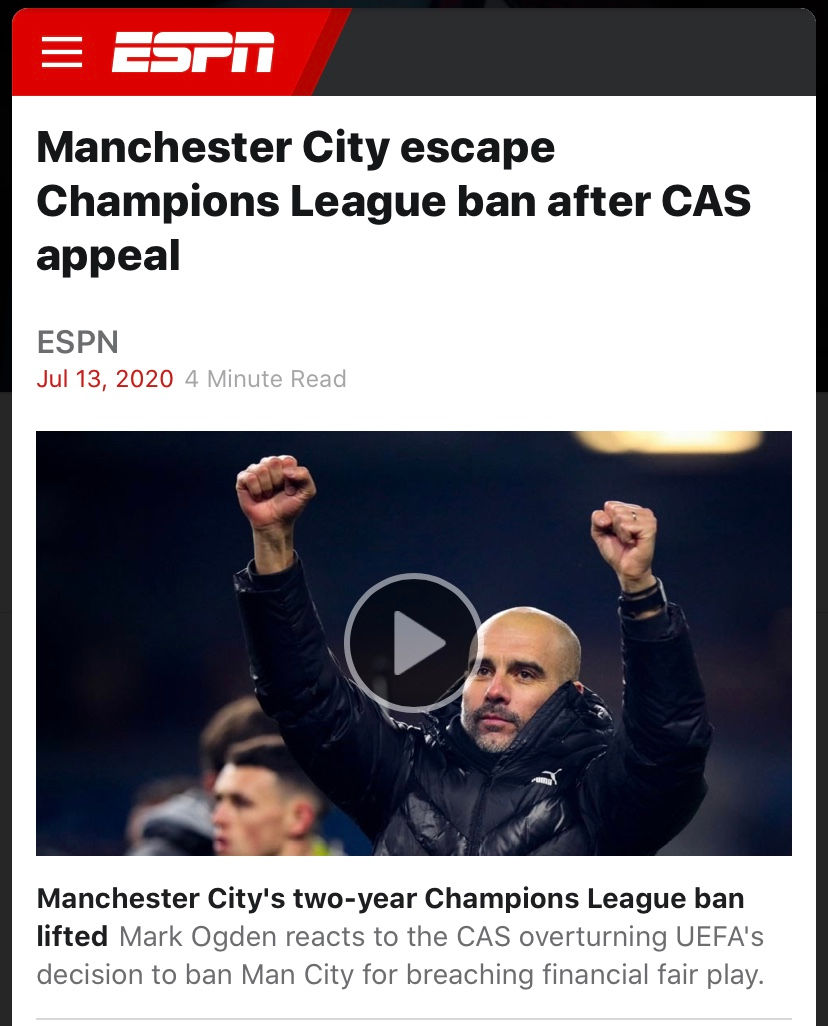

The contrast in bans between elite clubs like Manchester City and non-elite clubs like Panathinaikos.
Due to the fact that European competition is now so profitable it isn't surprising clubs from smaller nations are spending more money to chase potential success and grow their fan bases around the world. However; football isn't a profitable business model and it should be viewed as such. Ultimately, FFP has proven to only put a potential band aid on the problem that now pervades the game: owners looking to make profits out of clubs instead of making them efficient community enterprises. This has led to leveraged buyouts, third party ownership, and owners who just care more about the balance sheet than the community enterprise that the game can be.
The oddest part of FFP is that in the process of regulating spending it has not made European football more equal but instead has entrenched the already elite clubs who exist in the game thus making a European Super League seem more imminent. While FFP may have helped some smaller clubs out of insolvent situations in the short term, it has kept the same system alive.
COVID-19 and the resulting economic impact looks to have only accelerated the already dire state some clubs find themselves in. FFP is just a mere response to a larger underlying problem, finding a sustainable ownership and business model for an industry that isn't meant to make profits in the first place. This explains why so many fans are at times disillusioned with "modern football".
FFP and how it has been implemented is one of the most important conversations to have about football because the rules and models off the field affect the professional product on the field.
While we should applaud UEFA for their response to the issue, they haven't addressed the heart of the problem, therefore the same patterns will keep reproducing themselves. FFP might have had the right intentions but it hasn't gone far enough when it comes to sustainable business models for long term sustainability, more equal competition formatting, and proper ownership groups in smaller domestic leagues.



Comments